Publications

CAWP research and research by CAWP scholars that addresses emerging questions about American women's political participation. 

Reset Filters
  • Report
    Jul 26, 2017

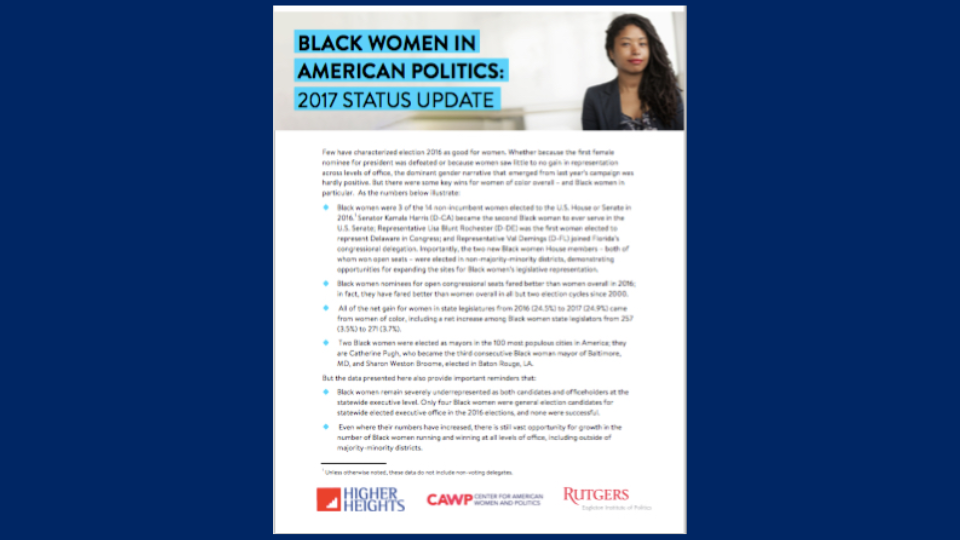
    Black Women in American Politics: 2017 Status Update
    This update highlights the key wins for women of color overall – and Black women in particular - in election 2016. The data demonstrate that, even with the gains Black women saw at some levels of office in 2016, there is more work to do to ensure that Black women’s representation in elected office reflects their presence in American society. 

  • Report
    Jun 9, 2017

    Representation Matters: Women in the U.S. Congress
    This CAWP report takes stock of the experiences, perspectives, approaches, and influence of women in the U.S. Congress. Drawing upon the CAWP Study of Women in the 114th Congress, entailing original interviews with 83 of the 108 women who served as senators, representatives, and delegates in the 114th Congress (2015-2016), it shows that women members on both sides of the aisle very much believe that their presence and their voices matter. The interviews provide considerable evidence of women's achievements despite the overall environment of gridlock and party polarization in which the women in Congress operate.

  • Report
    May 22, 2017

    Finding Gender in Election 2016

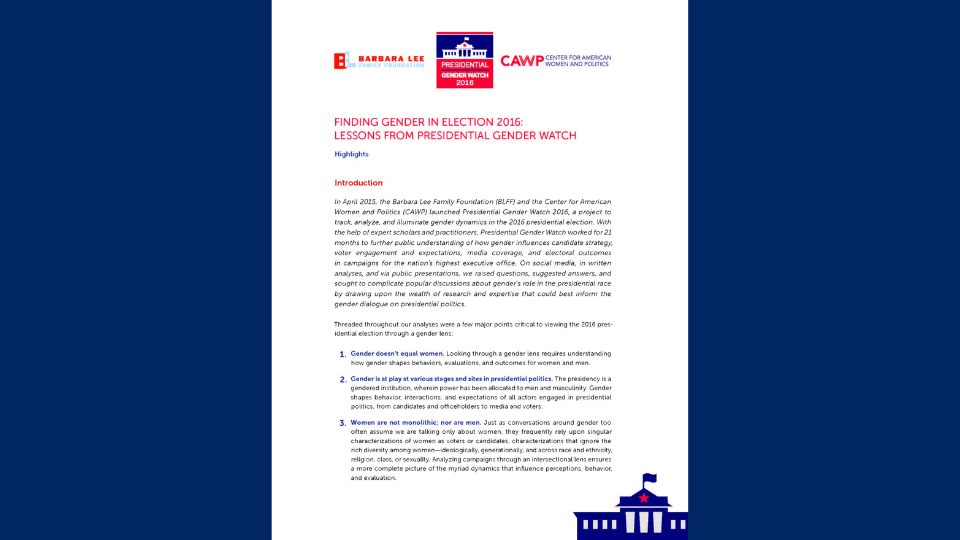
    In April 2015, BLFF and CAWP launched Presidential Gender Watch 2016, a project to track, analyze, and illuminate gender dynamics in the 2016 presidential election. With the help of expert scholars and practitioners, PGW worked for 21 months to further public understanding of how gender influences candidate strategy, voter engagement and expectations, media coverage, and electoral outcomes in campaigns for the nation’s highest executive office. This report outlines key ways in which gender was at play in the presidential election.

  • Report
    May 22, 2017

    Finding Gender in Election 2016: Highlights
    Highlights from the report about Presidential Gender Watch 2016, a project to track, analyze, and illuminate gender dynamics in the 2016 presidential election. With the help of expert scholars and practitioners, PGW worked for 21 months to further public understanding of how gender influences candidate strategy, voter engagement and expectations, media coverage, and electoral outcomes in campaigns for the nation’s highest executive office. 

  • Article
    Mar 2, 2017

    Ask a Feminist: A Conversation with Susan J. Carroll on Gender and Electoral Politics

    An interview with CAWP senior scholar Susan J. Carroll about gender and electoral politics in Signs: Journal of Women in Culture and Society , Vol. 42, No. 3, Spring 2017, pgs.  771-783

  • Report
    Feb 14, 2017

    Candidates Matter: Gender Differences in Election 2016

    We looked at gender and party differences in candidate numbers and success in election 2016 to better understand why women made so little progress in representation. Our data demonstrates, consistent with research to date, that there appears to be no consistent gender disparity in candidate win rates; the real gender disparities exist in the proportions of women and men running at each phase of the electoral process. These conclusions are consistent across party, though the dearth of women candidates is particularly acute in the Republican party. 

  • Report
    Jan 3, 2017

    Women in the 115th Congress

    In 2017, 104 (78D, 26R) women hold seats in the U.S. Congress, comprising 19.4% of the 535 members; 21 (16D, 5R) women (21%) serve in the U.S. Senate and 83 (62D, 21R) women (19.1%) serve in the U.S. House of Representatives. 

  • Book Chapter
    Nov 6, 2016

    Women’s Decisions to Run for Office: A Relationally Embedded Model

    This chapter presents an alternative approach to the standard ambition model of candidacy. The authors analyze state legislators’ decisions to seek elective office using the 2008 and 1981 CAWP Recruitment Studies. The analysis reveals that a traditional model of ambition, in which candidacy is self-initiated, offers a less adequate account of how women reach office than of how men do so. The authors argue for an alternative model of candidacy, one that seems to apply more often to women than to men, that recognizes running for office as an embedded decision.

  • Report
    Oct 25, 2016

    #WomenRun2016: U.S. House Outlook

    What will the U.S. House of Representatives look like in 2017? Combining CAWP data with race ratings from the Cook Political Report reveals that women may well reach a new high in numerical representation in the 115th House, but that outcome relies upon favorable breaks in the most competitive races. Moreover, the most positive outcomes in 2016 are likely to come for Democratic women candidates, who are best situated to take new seats, while Republican women are likely to see a net loss in their ranks.

  • Article
    Jul 1, 2016

    Women in State Government: Still Too Few

    In recent years the movement of women into state-level offices has slowed after several decades of gains. Efforts to actively recruit women for elective and appointive positions will be critical in determining what the future holds for women in state government.

Showing 41 to 50 of 168 resources