When You See Me, Do You Hear Me? The Persuasive Power of Black Women
“Support Black Women. Believe Black Women. Thank Black Women.” These phrases have entered popular discourse to acknowledge an important inequality regarding who receives support, belief, and gratitude. They also emphasize the unique political role and contributions of Black women who comprise a substantial base of the Democratic Party and have been at the forefront of recent civil rights movements, such as Black Lives Matter (BLM) and the #MeToo movement.
Despite Black women’s central roles in activism and advocacy, they also face several obstacles. Black women are both hypervisible and invisible (Newton 2023), which often leads to expectations that they will speak for all members of their group while they are simultaneously denied opportunities for institutional advantages. And, despite this unfair treatment, Black women often remain in organizing spaces where they are not heard, continuing to push for goals they consider essential (Brown 2021). Unfortunately, we know little about the barriers that Black women may face in communicating social movement messages to broad audiences. Are Black women as effective messengers as Black men, white women, or white men? Do their messages have similar effects on groups that vary by race and gender?
In this project, we ask how Black women adapt to challenges and shape persuasion strategies? Outside of organizing spaces, how do they convey their messages, and how do others receive them? Drawing on interviews with Black women activists and advocates, as well as an original survey experiment, we find that:
- Black women are strategic and craft specialized messages tailored to specific audiences.
- Black men and women find Black women to be effective and trusted messengers.
- When supporting an issue that white audiences dislike, white audiences view Black women as less effective messengers.
Why does this research matter?
In this project, we examine the persuasive opportunities and challenges that Black women encounter in their work as activists, centering Black women as research subjects and focusing on activism as a critical form of political engagement and influence.
Black women comprise a relatively small group, representing approximately 8% of the total U.S. population (U.S. Census Bureau 2024), which means achieving political goals requires effective coalition building. As scholars point out, “Black women have always fought for one another and everyone else on the frontlines of political action, but for Black women to have their concerns addressed, people beyond Black women have to show up for them” (Crowder 2025, p. 5).
The perspective of Black women remains vital in activist and political spaces because they offer distinct contributions. Black women’s political participation is integral not only because they bring their unique voices and perspectives, but also because they emphasize intersectionality in ways others do not, focusing on the needs of groups that may otherwise be overlooked (Crowder-Meyer 2022; Brown et al. 2017; Brown 2014).
How did we do our research?
How do Black women activists shape their strategies to influence others? How do different audiences perceive their messages? To address these two questions, we used two different methods.
First, to explore the strategies Black women activists use to influence others, we conducted eleven Zoom interviews with Black women and non-binary organizers, activists, and advocates between October 2023 and March 2024. We asked open-ended questions about their work, their identity within it, and their approach to creating effective messages. During our interviews, we gained insight into the techniques and mechanisms that Black women use to frame their messages and convey their organizations’ goals. Still, it was not explicitly clear how these messages were received and if they persuaded or moved the audiences.
We used insights from these interviews to design a survey experiment to investigate differences in perceptions of Black women, white women, Black men, and white men among different audiences.
What did we find?
Identity and positionality are ever-present in activists' minds.
A clear theme emerging from our interviews is that identity and positionality are ever-present in activists' minds. They emphasized how their race and gender shape the people who listen to them and how they approach their work. As one activist noted, “I could use my identity as a weapon, or I could use it as a unifying factor.” Some interviewees told us that their identity helps them reach out to communities with whom they are organizing in solidarity. Many organizers shared with us how their personal commitments to racial and gender groups influence their work.
So whenever I put pen to paper, or whenever I craft a social media post, or whenever I am working on this messaging guide, or whenever I'm doing anything — [what] is really at the center of my work is…what work will I do to humanize Black people this week? And that's the mindset I go into when I work on messaging. And I think that is a part of the effort to change hearts and minds again. That’s part of the work that we do.
Many activists also emphasized the importance of cultivating intersectional leadership to bring diverse voices into the conversation among rank-and-file members.
We found that in order to raise their voices, that putting [Black women] in leadership is often the only time that they will actually be heard and [will ensure] that they have those experiences in leadership to tell their stories.
But identities were not always seen as benefiting these activists and advocates. Especially when considering elite audiences, activists noted that their identity can sometimes limit their ability to reach individuals, and they emphasized the importance of collaborating with other organizations and community members to expand their reach in those circumstances. And, even within their organizations, they noted that clashing identities can be a source of tension.
White people come into this space. Some of them are very intimidated. I've had issues as a board member, honestly, in some cases where, like, older white folks feel intimidated [when] younger people of color come into the space and have different ideas, and they [are especially intimidated] if they're longtime members of [the organization] or longtime members of the community.
Activists acknowledged facing credibility challenges related to their identity. However, they underscored the importance of their work and centering Black women’s experiences as an essential political strategy. Similarly, our interviewees were forthcoming with how they changed or, at times, even censored their messages to meet audiences that did not share a similar background.
If I'm in a mixed space or a white space, everything has to be measured right because you have to consider the feelings of someone else. And it’s always that, whereas, like in a group of Black and brown folks… we talk to each other differently.
Similarly, an activist involved in DEI training for nonprofits discussed the need to occasionally change the seminar topic to engage those who were unfamiliar with DEI work. “You have to meet people where they are.” This adaptive messaging strategy aligned with strategies adopted by other activists we interviewed.
Personal narratives and statistics appeal to different audiences.
As we conceived of the project, we imagined focusing on how activists frame messages for public audiences. However, as we completed these interviews, it became clear that activists also consider other messaging strategies. Our conversations revealed that their strategies were nuanced, depending on the recipient, and they tailored messages accordingly. In particular, and without prompting, multiple activists expressed the challenges they face in tailoring their messages not only to the general public but also to various stakeholders such as boards of directors and potential donors. The influence of these audiences on activist communication adds a dimension to the challenges activists face in their messaging that we did not anticipate at the outset.
That said, certain themes emerged regardless of the audience these activists and advocates aimed to reach. In line with our expectations about messaging, interviewees emphasized the importance of personal testimony and narratives as effective communication strategies. Activists find that having people share their stories adds genuineness and legitimacy, convincing those who might not otherwise be persuaded. Some organizers we interviewed suggested that this was their most important tool.
A lot of the writing I've done this year…has been talking about what's been at risk…who's at risk when Roe v. Wade is rolled back, right? And now, we're in this space where there's like so many Black women, so many poor women, so many undocumented women who are struggling and having all of these specific issues. And it's only when you're able to connect the message to an actual person that folks throw up some kind of empathy or some kind of sympathy. So I think in my journey, in my years of doing messaging work, it's always about connecting with people's stories. I’m a person who believes that someone's lived experience is research.
Other interviewees discussed using their own stories to build support for their organizations. For instance, one participant discussed her career trajectory, illustrating how she benefited from some services her organization provided. She described using the organization's services as a younger, struggling mother who, years later, became a leader in the organization. Her personal experiences and identities helped her connect with funders, partner organizations, and people who came through the door from similar communities and circumstances. She relayed these experiences to us but also used them in her broader work. Leveraging these experiences mirrors the way Black women elected officials use personal narratives in their communication with voters (Wright 2023).
Many activists acknowledged, however, that relaying personal narratives does not resonate with all audiences. One interviewee, for example, explained that when trying to persuade legislators to vote for their objectives, they targeted narrative communications to Democrats while providing facts and figures to Republican legislators. “We lean on qualitative aspects for Democrats, quantitative/numbers for Republicans,” they explained. This organizer suggested that, in their experience, narratives were disbelieved more by Republican members when advocating for Black women’s policy priorities. Democratic legislators, she suggested, were more amenable to narrative persuasion.
Interviewees shared that they were more likely to use formal language and share data and visualizations to increase their credibility when talking with key stakeholders, particularly those who may not seem immediately aligned with the organization. For example, a leader of an organization focused on poverty alleviation noted her organization’s approach to reaching those in positions of power:
We talked about the fact that there were 600,000 households across [state redacted] already living at or below the poverty line, and that number doubled within months of COVID in [state]. And so we provided that data as well. And what was really powerful, we also provided testimonials from families. So we had families testifying in the state legislature about their experience[s] falling into poverty. Families who had a way to take care of themselves, pre-COVID, in fact, [had] never found themselves in a social service program seeking services before. So we had them tell their story, and we provided the data.
This coupling of narrative and statistics reflects organizers’ experiences that both tools can be powerful and may persuade different individuals to join their organizations’ causes.
Taken together, these interviews highlight how Black women activists and advocates view race and gender as integral components of their messages. They also emphasize the importance of using different types of messages, emphasizing personal narratives and/or statistical facts for various audiences.
Black men and women find Black women to be effective and trusted messengers.
In March and April 2025, we recruited a sample of participants (n=5,075, including an oversample of Black respondents (n=2,100)) to evaluate the messages of different speakers based on race and gender. Each participant evaluated five social media profiles and posts on three policy issues, totaling 15 profile views. We were interested in how respondents evaluated the profile and messages, as well as whether they would continue to seek out information from those sources (which we gauged by asking if they would “follow” a particular user). We included posts on three different topics: cash bail reform, tariffs, and parental leave (see the appendix for examples and more details on methodology).
In the profiles that respondents saw, we varied several kinds of content, but our key experimental features were:
- Race (Black/white) and gender (woman/man) of the speaker
- Message type (narrative only, facts only, narrative+facts)
- Direction of the message (pro/con)
After reviewing the profiles, we asked respondents to assess several outcomes, including overall effectiveness, whether they would follow this person in the future, and whether they would donate to a cause the person recommended. For the purpose of this analysis, we focus on the decision to follow the person whose profile they examined. This question allowed respondents to say “yes” or “no” to whether they would follow the person. This outcome provides a sense of the kinds of information and perspectives people would choose to expose themselves to in the future.
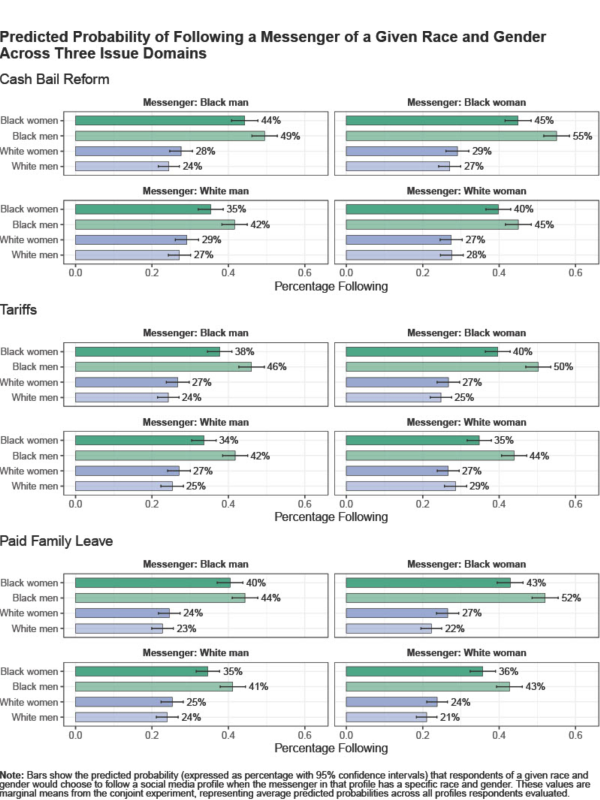
Figure 1 shows how likely people were to follow the profile of the person whose argument they saw, characterized as “predicted probabilities” that they would follow that profile. So, for example, when the messenger for cash bail reform is a Black woman, Black women respondents were around 45% likely to follow that messenger, Black men were the most likely to follow (at 55%), and white women and white men were 29% and 27% likely to follow a Black woman messenger, respectively.
A few trends emerge. First, Black women messengers were not uniquely disadvantaged; respondents across racial and gender groups said they would follow Black women messengers at levels similar to messengers of other race/gender identities. Second, these Black women messengers were especially likely to be followed by our Black respondents — Black women and, especially, Black men. This seems to reflect a broader pattern in which Black respondents were much more likely than others to say they would follow messengers – all messengers – regardless of race or gender.
Figure 1
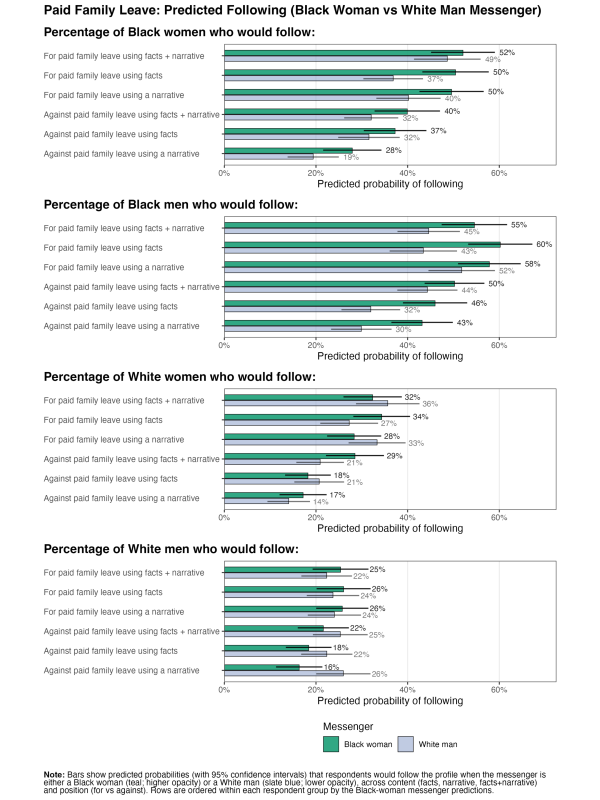
In addition to messenger identity, we varied how the message was delivered (facts, narrative, or both) and whether it supported or opposed the policy. To illustrate how these elements interact, we focus on paid family leave — an issue for which we anticipated that women’s voices might carry particular weight.
Because our broader interest centers on Black women as political messengers, Figure 2 compares responses to a Black woman messenger with responses to a white man messenger. We use white men as a comparison group because they represent a voice that is often privileged in American politics. By contrasting these two messengers while holding the content and direction of the message constant, we can more clearly isolate how messenger identity shapes people’s willingness to follow them. Within each group of respondents, the figure shows how people of that gender and race responded to the same message when it was delivered by a Black woman versus a white man. By comparing reactions to identical messages across these two messengers, we can isolate the independent role of messenger identity and see how it interacts with the message’s content and argument.
Several clear patterns emerge.
First, across nearly all respondent groups, messages supporting paid family leave were more likely to generate follows than messages opposing it. Arguments against paid leave were consistently among the least likely to attract followers. This suggests that audience receptivity to the policy itself strongly shapes willingness to engage with a messenger, regardless of who is speaking.
Second, messages that combined facts and personal narrative often performed particularly well, especially when supporting paid leave. Among Black women and Black men respondents, a Black woman supporting paid family leave using both facts and narrative generated some of the highest follow rates. Messages that used only facts or only narrative also attracted followers, but combining the two was often among the strongest approaches.
Importantly, the comparison between messengers reveals meaningful differences. Among Black respondents, the Black woman messenger consistently outperformed the white man messenger when advocating for paid leave, particularly when she incorporated evidence or a mix of evidence and lived experience. In these cases, messenger identity amplified the effect of message style.
Among white women, the gap between the Black woman and white man messenger was smaller, though supportive messages still performed better than oppositional ones, regardless of who delivered them. Among white men, overall follow rates were lower across the board, and differences between the Black woman and white man messengers were more modest. Still, support messages tended to outperform opposition messages for both messengers, with Black women messengers benefiting most.
Taken together, these results reinforce that there is no single communication strategy that works equally well across audiences. Supportive messages generally attracted more engagement than oppositional ones and combining facts with narrative was often effective. However, the comparison between Black women and white men shows that messenger identity meaningfully shapes how these messages are received — and that the advantages or disadvantages of a messenger depend heavily on the audience evaluating them.
Figure 2
Implications
Our results suggest that Black women can be a uniquely persuasive force in politics, but they also suggest some clear limits. The activists and advocates we interviewed demonstrated a willingness to tackle many prejudices and challenges, some rooted in their identities, to do work they believed in. In some ways, the survey experiment demonstrates that this work pays off. Particularly among Black respondents, Black women appear to be uniquely effective, trusted messengers. When communication is directed at Black audiences, Black women messengers can effectively reach them and align them with their communicative goals. And, when communication is directed to white audiences, Black women are followed at similar rates to other groups.
That said, there is a clear difference between social media and in-person attempts to persuade. Our interviewees leveraged multiple formats to reach audiences, and we do not know whether these same patterns hold for in-person conversations. There may be different opportunities to reach audiences through various formats.
Our results have several implications.
- Organizations seeking to reach Black audiences (especially Black women) would be wise to use Black women messengers. And, even for other groups, Black women are followed at similar rates to other messengers. Across our three issues, Black women are as likely as other messengers to elicit followers across race and gender groups and more likely to elicit followers among Black constituencies. This suggests that Black women messengers may be especially effective at generating interest and follows on social media.
- That said, Black women were not as readily followed by white audiences. So this may also suggest that organizers and advocates should continue to focus on building respect for and understanding the political authority of Black women, particularly among white audiences.
- Our interviewees and our survey experiment both emphasize that combining narrative with facts makes for particularly compelling messages in both online and in-person communication.
-
Researchers should continue investigating how other groups' perceptions of Black women may pose both challenges and opportunities (e.g., messaging directed to Black communities) across a wide array of issues.
References
Bejarano, Christina, and Wendy Smooth. 2022. "Women of color mobilizing: Sistahs are doing it for themselves from GOTV to running candidates for political office." In Women of Color Political Elites in the US, pp. 8-24. Routledge.
Bonilla, Tabitha, and Alvin B. Tillery. 2020. "Which identity frames boost support for and mobilization in the #BlackLivesMatter movement? An experimental test." American Political Science Review 114(4): 947-962.
Brown, Karlia Nicole. 2021. "Why black women activists stay in the room when they are not being heard." Social Science Quarterly 102(7): 3073-3080.
Brown, Melissa, Rashawn Ray, Ed Summers, and Neil Fraistat. 2017. "# SayHerName: A case study of intersectional social media activism." Ethnic and Racial Studies 40(11): 1831-1846.
Brown, Nadia E. Sisters in the statehouse: Black women and legislative decision making. Oxford University Press, 2014.
Brown, Nadia, and Kira Hudson Banks. 2014. “Black Women’s Agenda Setting in the Maryland State Legislature.” Journal of African American Studies 18 (2): 164-180.
Brown, Nadia E., and Sarah Allen Gershon. 2021. "Glass half full: cautious optimism and the future of black women political elites in America." Journal of Race, Ethnicity, and Politics 6(1): 3-15.
Crowder, Chaya. 2025. Intersectional Solidarity: Black Women and the Politics of Group Consciousness. New York, NY: Oxford University Press.
Crowder-Meyer, Melody. 2022. "How gender, race, ethnicity, and their intersections shape Americans’ issue priorities." Journal of Women, Politics & Policy 43(2): 169-183.
Dittmar, Kelly, Kira Sanbonmatsu, and Susan J. Carroll. 2018. A Seat at the Table: Congresswomen’s Perspectives on Why Their Presence Matters. New York, NY: Oxford University Press.
Dowe, Pearl K. Ford. 2020. "Resisting marginalization: Black women’s political ambition and agency." PS: Political Science & Politics 53(4): 697-702.
Garza, Alicia. “A Herstory of the #BlackLivesMatter Movement.” The Feminist Wire. October 7, 2014. Retrieved on September 20, 2025 from: https://thefeministwire.com/2014/10/blacklivesmatter-2/
Gay, Claudine, and Katherine Tate. 1998. "Doubly bound: The impact of gender and race on the politics of black women." Political Psychology 19(1): 169-184.
Haines, Errin. “Why Aren’t Black Women in the Conversation to Lead the Democratic Party?” The 19th. December 6, 2024. Retrieved on September 15, 2025 from: https://19thnews.org/2024/12/black-women-democratic-party-leadership/
Han, Hahrie. 2016. "The organizational roots of political activism: Field experiments on creating a relational context." American Political Science Review 110( 2): 296-307.
Harris-Perry, Melissa V. Sister citizen: Shame, stereotypes, and Black women in America. Yale University Press, 2011
Heaney, Michael T. 2022. "Who Are Black Lives Matter Activists? Niche Realization in a Multimovement Environment." Perspectives on Politics 20(4): 1362-1385.
Jordan-Zachery, Julia S. Shadow bodies: Black women, ideology, representation, and politics. Rutgers University Press, 2017.
Mosley, Tonya. “MeToo Founder Tarana Burke says Black Girls Trauma Shouldn’t be Ignored. NPR.org. September 29, 2021. Retrieved on October 1, 2025 from: https://www.npr.org/2021/09/29/1041362145/me-too-founder-tarana-burke-says-black-girls-trauma-shouldnt-be-ignored
Newton, Veronica A. 2023. "Hypervisibility and invisibility: Black women’s experiences with gendered racial microaggressions on a white campus." Sociology of Race and Ethnicity 9 (2): 164-178.
Smooth, Wendy, and Elaine Richardson. 2019. “Role models matter: Black girls and political leadership possibilities.” The Black Girlhood Studies Collection (Ed. Aria S. Halliday). Canadian Scholars Press, pp. 131-156.
Stokes‐Brown, Atiya Kai, and Kathleen Dolan. 2010. "Race, gender, and symbolic representation: African American female candidates as mobilizing agents." Journal of Elections, Public Opinion and Parties 20(4): 473-494.
Wright, Andrene Z. 2023."Telling the Tale: Black Women Politicians and Their Use of Experiential Rhetoric." Politics & Gender 19(4): 1007-1034.
Appendix
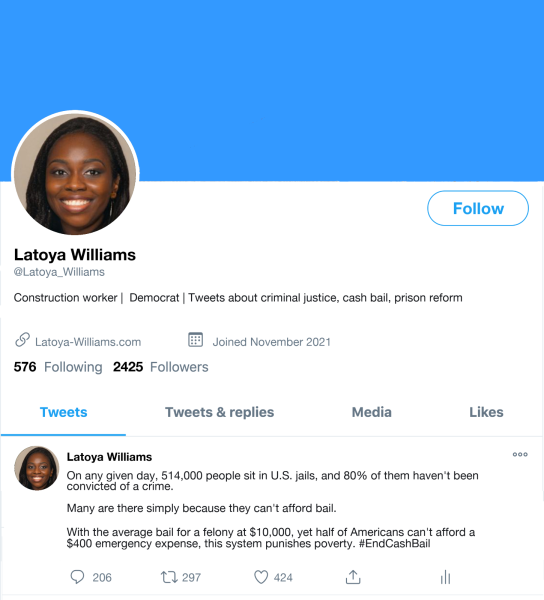
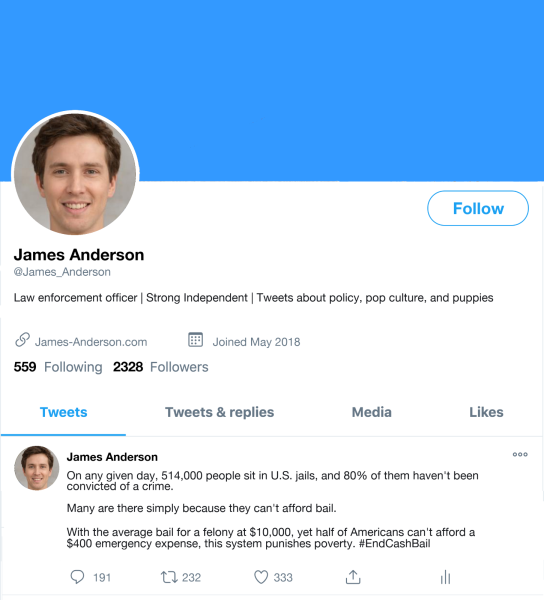
Below are two examples of messages (for cash bail reform) shown to survey participants. We chose this format for two reasons. First, many of our interviewees discussed the importance of social media messaging. Additionally, social media is a way many people encounter political messages. It is also a format that is easy to dismiss, overlook, and disengage with messengers, as people can quickly scroll through, ignore, and choose not to follow messengers they encounter on their phones.