Women Voters Power Democratic Wave Election
Analysis of Voter Data from CAWP
Women voters were crucial to Democratic victories in the 2026 midterms, according to an analysis of voter survey data from the Center for American Women and Politics (CAWP), a unit of the Eagleton Institute of Politics at Rutgers University. For a full analysis of gender and voting in this year’s election, with data visualizations, read Women Voters Critical to Democrats’ Success in the 2026 Election.
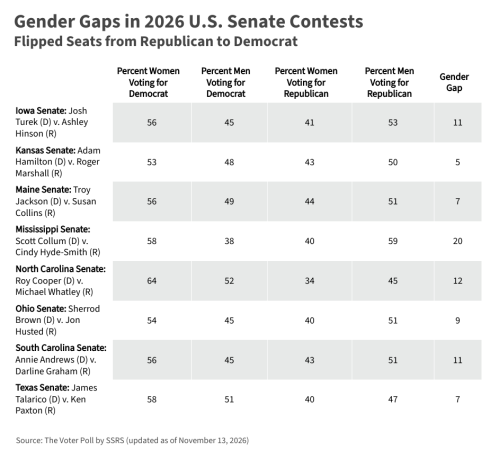
“Women voters aren’t a monolith, but they were more likely than men to back Democrats across all race/ethnic, education, and age groups,” said CAWP Director of Research Kelly Dittmar. “Women’s votes were critical to the outcome of the 2026 midterms, and were particularly crucial in some of the closest races. A 20-point gender gap in the Mississippi Senate race helped flip this seat for the first time in more than three decades.”
Gender gaps in vote choice refer to a difference between the percentage of women and the percentage of men voting for a given candidate, generally the winning candidate. Even when women and men favor the same candidate, they may do so by different margins, resulting in a gender gap. In every presidential election since 1980, a gender gap among all voters ranging from four to 12 points has been apparent, with a greater proportion of women than men preferring the Democrat in each case. Women have consistently been more likely to back Democrats in midterm election years as well.
2026 Gender Gaps in Vote Choice
CAWP analysis of The Voter Poll by SSRS illuminates the role of women voters in Democratic candidates’ success.
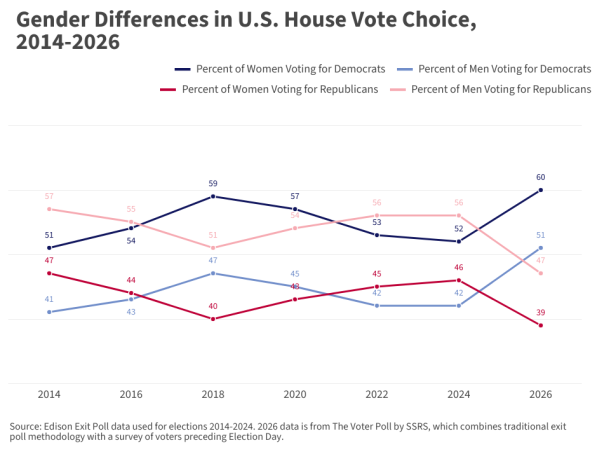
- U.S. House A sizable majority of women, 60%, compared with 51% of men, reported casting ballots for the Democratic congressional candidate in their district. This nine percentage-point difference is similar to the ten-point gender gap in the House vote in the 2024 election, when 52% of women and 42% of men voted for Democratic House candidates.
- U.S. Senate Women’s votes were critical to flipping eight U.S. Senate seats from Republican to Democrat. The gender gaps in vote choice across these contests ranged from five to twenty points. The gender gap in vote choice was the largest, by far, in Mississippi, where women’s support for Senator-elect Scott Colom was 20 percentage points higher than men’s.
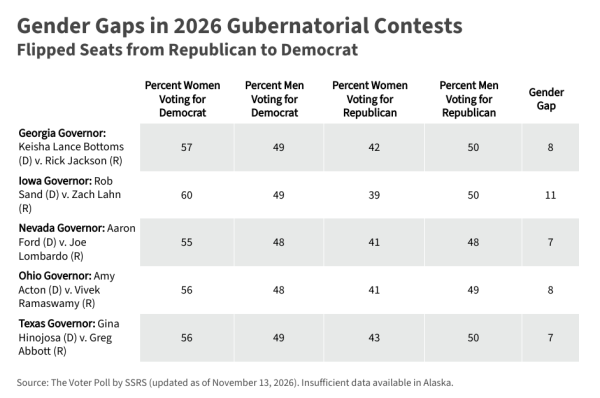
- Gubernatorial Offices Women fueled Democratic victories in states that flipped from Republican to Democratic governors. The gender gaps in vote choice across these contests ranged from seven to eleven points, the largest being the 11-point gender gap in the Iowa gubernatorial election.
Race and Ethnicity in Vote Choice for U.S. House
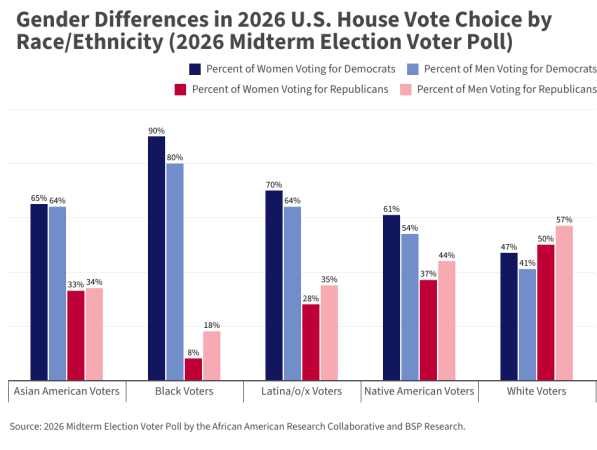
Women voters – like men – are not monolithic, as evident in the fact that Black women, Latinas, college-educated white women, and young women supported Democratic House candidates at the highest levels, while majorities of non-college-educated white women and white evangelical women supported Republican House candidates. The 2026 Midterm Election Voter Poll, conducted by BSP Research and the African American Research Collaborative, incorporates more sophisticated and robust sampling of racial minority voters than other voter surveys. CAWP analysis of this data shows:
- 65% of Asian American women voted for Democrats.
- 90% of Black women voted for Democrats.
- 70% of Latinas voted for Democrats.
- 61% of Native American women voted for Democrats.
- 47% of white women voted for Democrats.
For the full analysis of women voters in the 2026 elections, with data visualizations and a detailed analysis by race/ethnicity and gender that compares data from The Voter Poll and the 2026 Midterm Election Voter Poll, visit Women Voters Critical to Democrats’ Success in the 2026 Election. Select data visualizations follow.